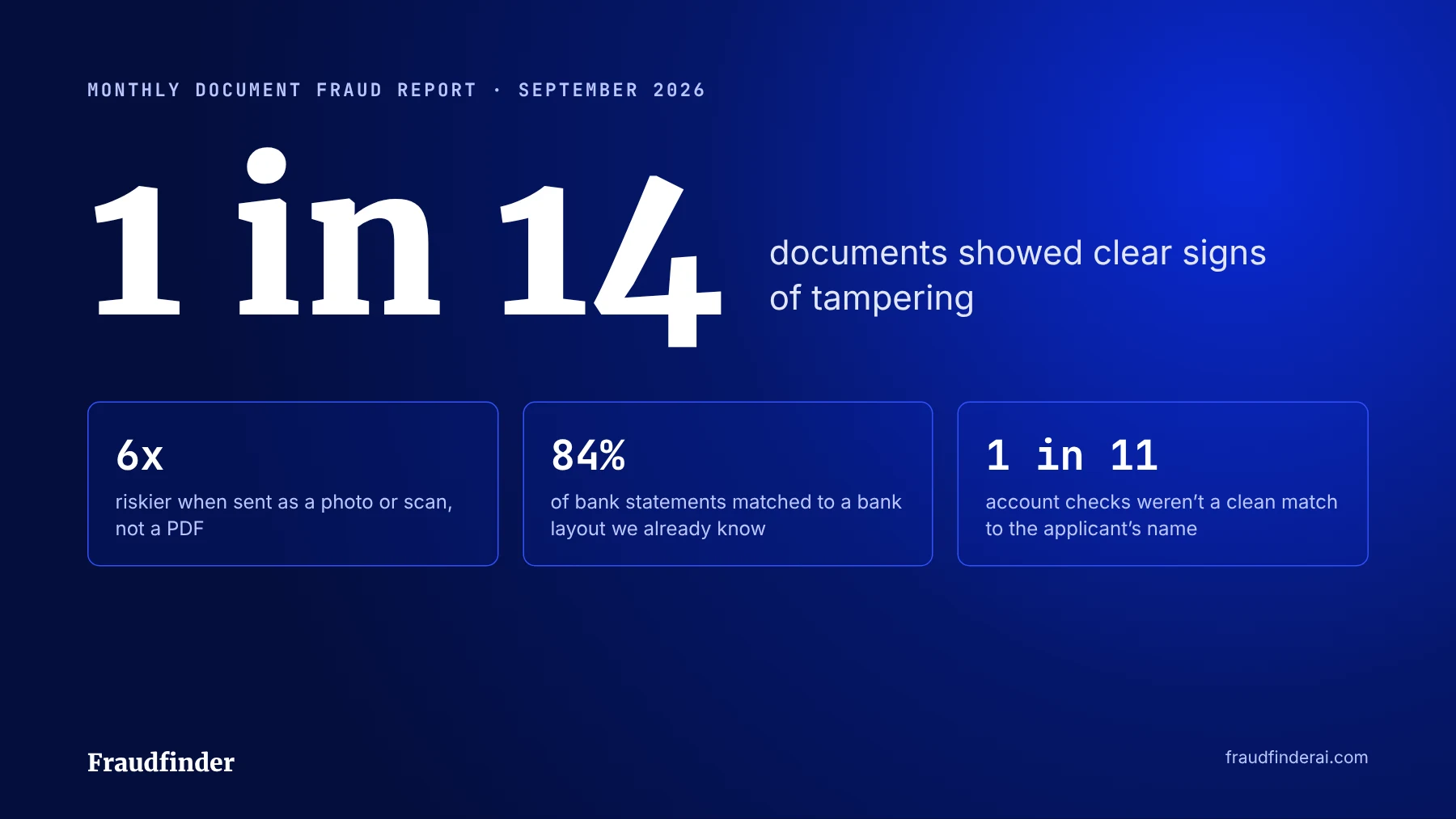
Around 1 in 14 documents we checked in September showed clear signs of tampering. Not a hunch or a "maybe". A changed number, an edit history inside the file, or a document that had been through editing software before it reached the review team.
That's the headline. The interesting bit is where it was hiding.
What did we look at?
Every document run through Fraudfinder in September 2026 by lenders, landlords, letting agents and gambling operators. Mostly UK, with a good spread of documents from Europe, the US/Canada and Australia.
This report strictly only counts documents with clear evidence of tampering, removing flags that may have been issued for things like new bank templates etc. It makes the numbers smaller. It also makes them more useful.
Bank statements made up the large majority of everything we checked, followed by utility bills and payslips as the next largest document types.
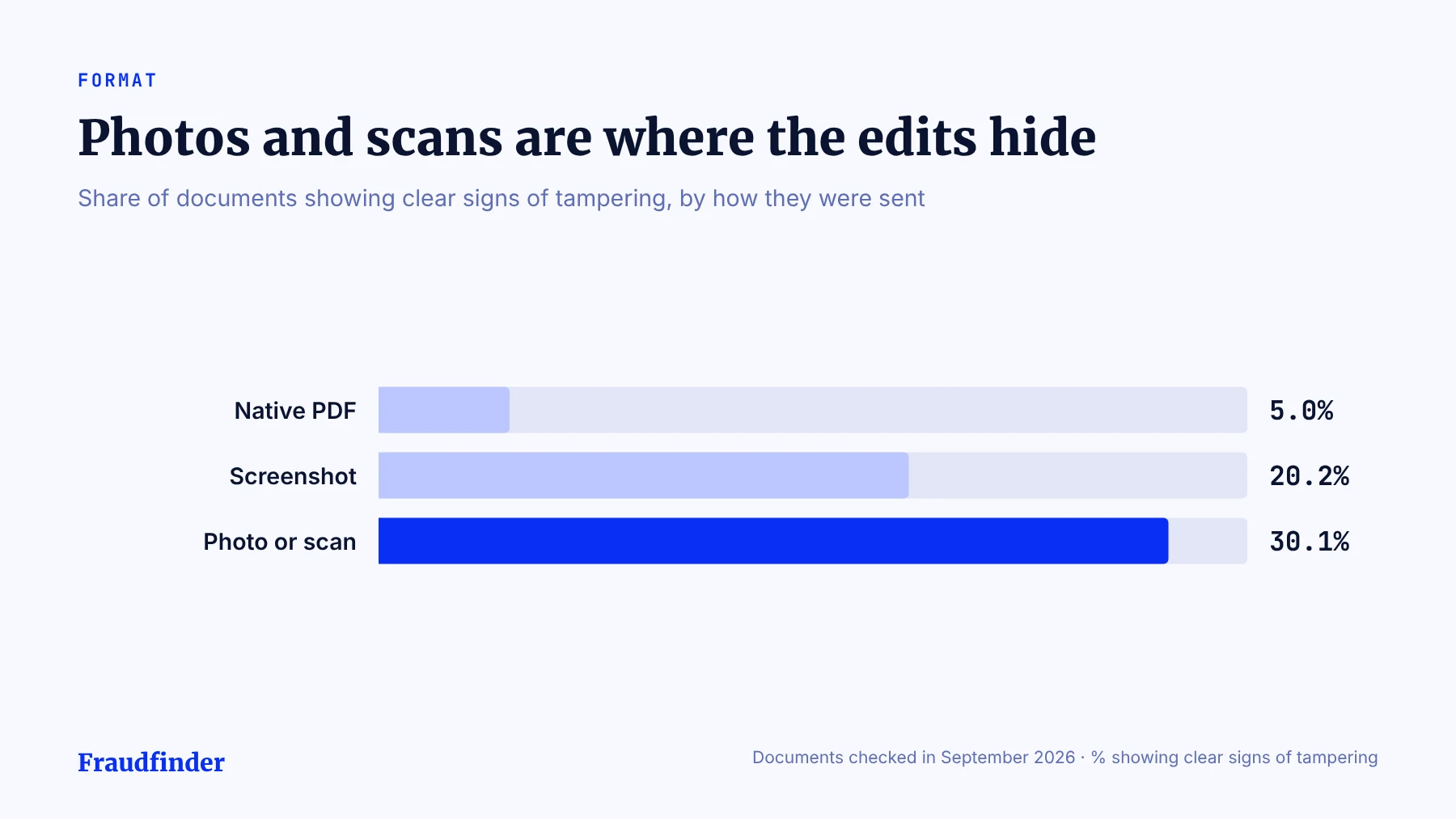
Are photos of documents riskier than PDFs?
Yes, by a distance.
- Native PDFs: 5.0% showed clear signs of tampering
- Screenshots: 20.2%
- Photos and scans: 30.1%
Narrow it to bank statements and it gets starker. Statements sent as a photo or scan were around 14 times more likely to show tampering than the PDF straight from the bank.
Why? A PDF from a bank carries a trail: what made it, when, and whether it's been changed since. Print it, edit it, photograph it, and most of that trail becomes murkier to follow. It's the cheapest way to launder an edit, and fraudsters know it.
That's why we're always looking for ways to create new fraud detection tests from the content itself as well as the structure of the files submitted.
Which documents got faked most in September?
Bank statements get most of the scrutiny, and they had the lowest tampering rate of the main document types. Payslips and utility bills both came in higher.
Part of that is format. Around 30% of the utility bills we saw arrived as photos or scans, against about 5% of bank statements, and photos carry more risk across the board. But even comparing PDFs only, payslips and utility bills showed tampering more often than statements.
It makes sense when you think about how they're used. A utility bill is "just" proof of address, so it often gets a glance and a tick. A payslip is one page with a handful of numbers on it. Both are easy to rebuild, and both tend to get less attention than the bank statement sat next to them. If you want the tells, we've written up how to spot a fake utility bill.
What does a tampered bank statement look like?
We matched 84% of the bank statements we saw in September to a bank layout we already know, and we add new layouts to that library every month. That matters, because knowing exactly how a bank builds its statements is one of the quickest ways to spot one that's been rebuilt.
The statements we hadn't seen before needed a closer look more often. Some were perfectly fine: smaller banks, overseas banks and business accounts can all look unusual. Others were stitched together from templates found online. Close enough to pass a glance. Not close enough to pass a layout check. Either way, each new layout gets reviewed and added, so the next one is recognised straight away.
Where we did recognise the bank, the most common tell was the file's own edit history. Elsewhere it was often numbers that simply didn't add up, which is exactly what bank balance reconciliation is built to catch.
Whose bank statements get faked most?
These are statements claiming to come from a bank. None of this says anything about the banks themselves.
Among the big names, TSB-branded statements stood out at 10.2%, around five times the average for recognised banks. That isn't just a photo problem: even looking only at PDFs, TSB stayed the highest of the major brands. We don't typically see TSB at the top, so this surge for September is quite surprising.
After that it gets tighter. Virgin Money (3.2%), RBS (2.7%), Halifax and Santander (both 2.4%) and Nationwide (2.1%) sat above average. The biggest names by volume, Lloyds (2.0%), HSBC (1.9%), NatWest (1.3%) and Barclays (0.9%), all came in lower.
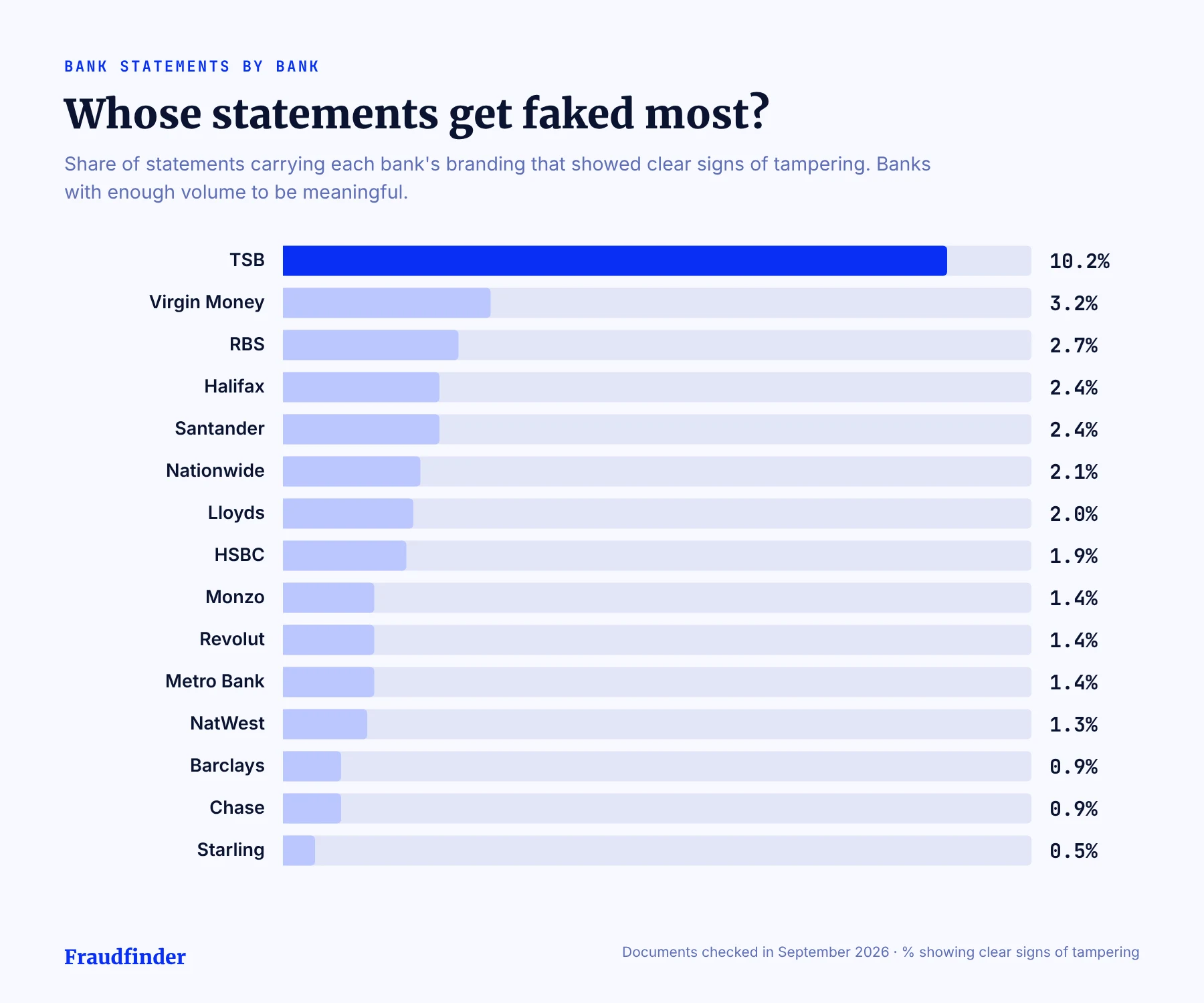
The digital-first banks were faked least this month. Statements branded Monzo, Starling, Revolut, Chase and similar showed clear tampering about half as often as the high street (1.0% against 1.8%).
Examples of document fraud we caught in September
Numbers are one thing. Here's what it actually looks like. Three documents from September, anonymised, with every name, address and account detail blurred.
1. A 2023 payslip brought back to life
An employee payslip from August 2023, rolled forward to look like it was issued in 2026. The dates were changed, every financial figure on the page was updated to match, and pay went up by about £1,400 along the way.
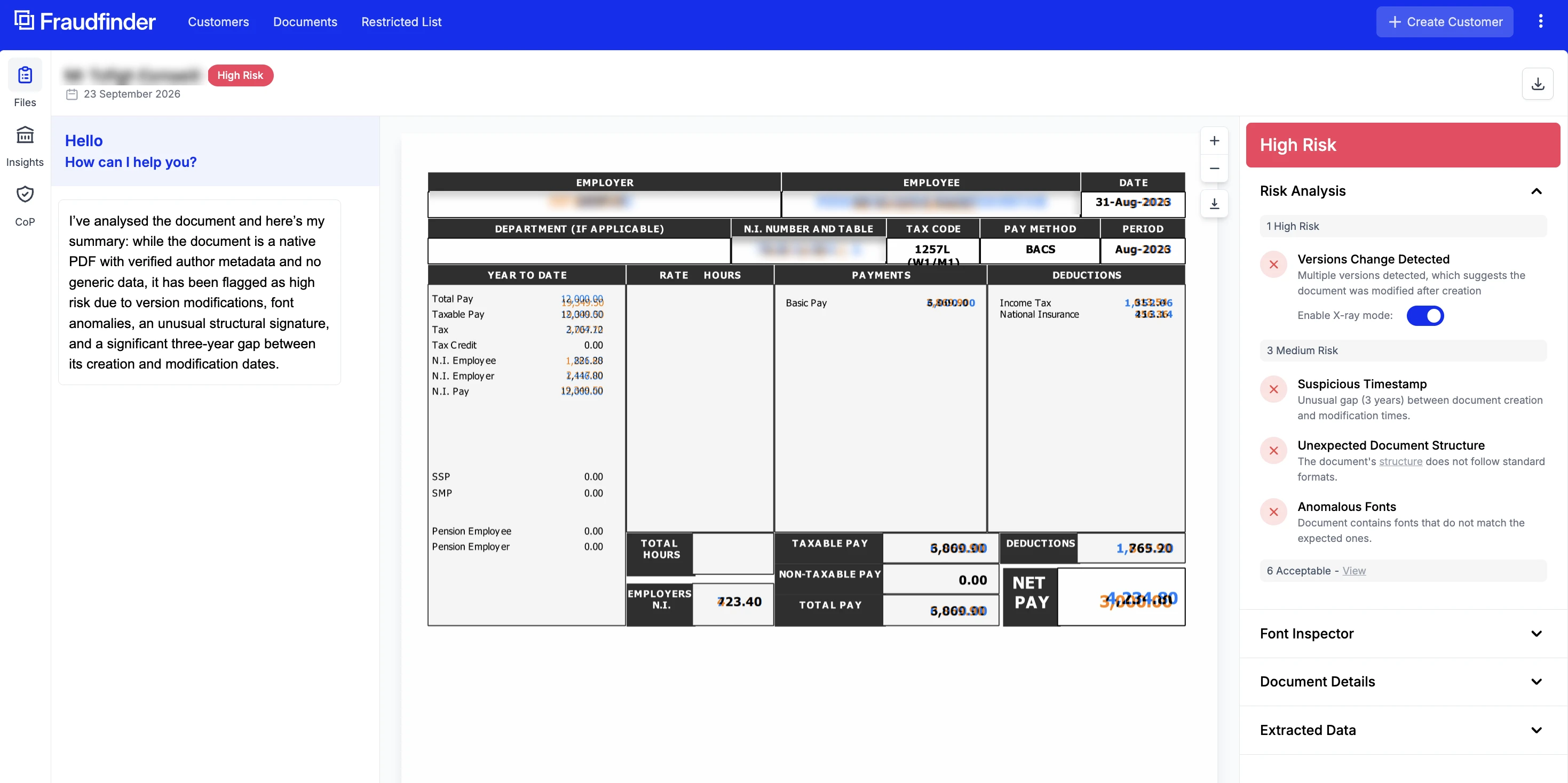
The giveaways sat under the surface: the file had been through dozens of versions, the fonts didn't match the rest of the document, its structure didn't follow the payslip's normal format, and there was a three-year gap between when the file was created and when it was last changed.
Old documents don't stay old. If the dates are all you check, a payslip from three years ago can pass as last month's.
2. A business bank statement with £100k added
A business current account statement where the opening balance went from £134.08 to over £100,800. To make it hang together, every running balance on the page was pushed up by the same amount.

Here's what the original summary actually said:
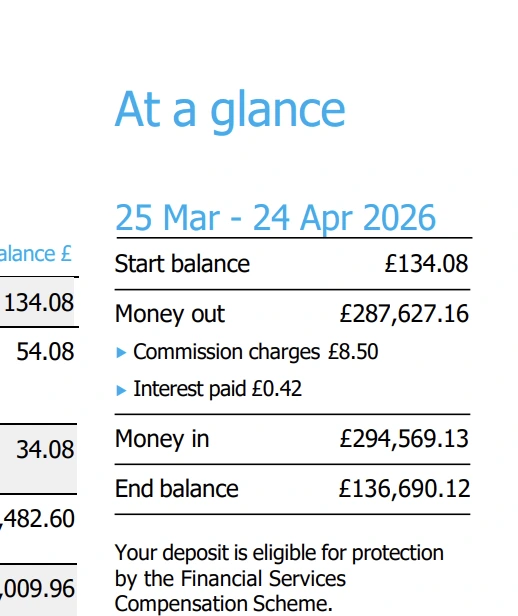
The transactions didn't reconcile with the balances printed next to them, the file showed footprints of Adobe and Microsoft Word (not software a bank uses to produce statements), and the fonts didn't match.
A £100k cushion that appears from nowhere is exactly the kind of thing bank balance reconciliation exists for.
3. A personal statement six figures richer
A personal bank statement where the opening balance was taken from £170.69 to more than £126,000, with the running balances on page one rewritten to match.
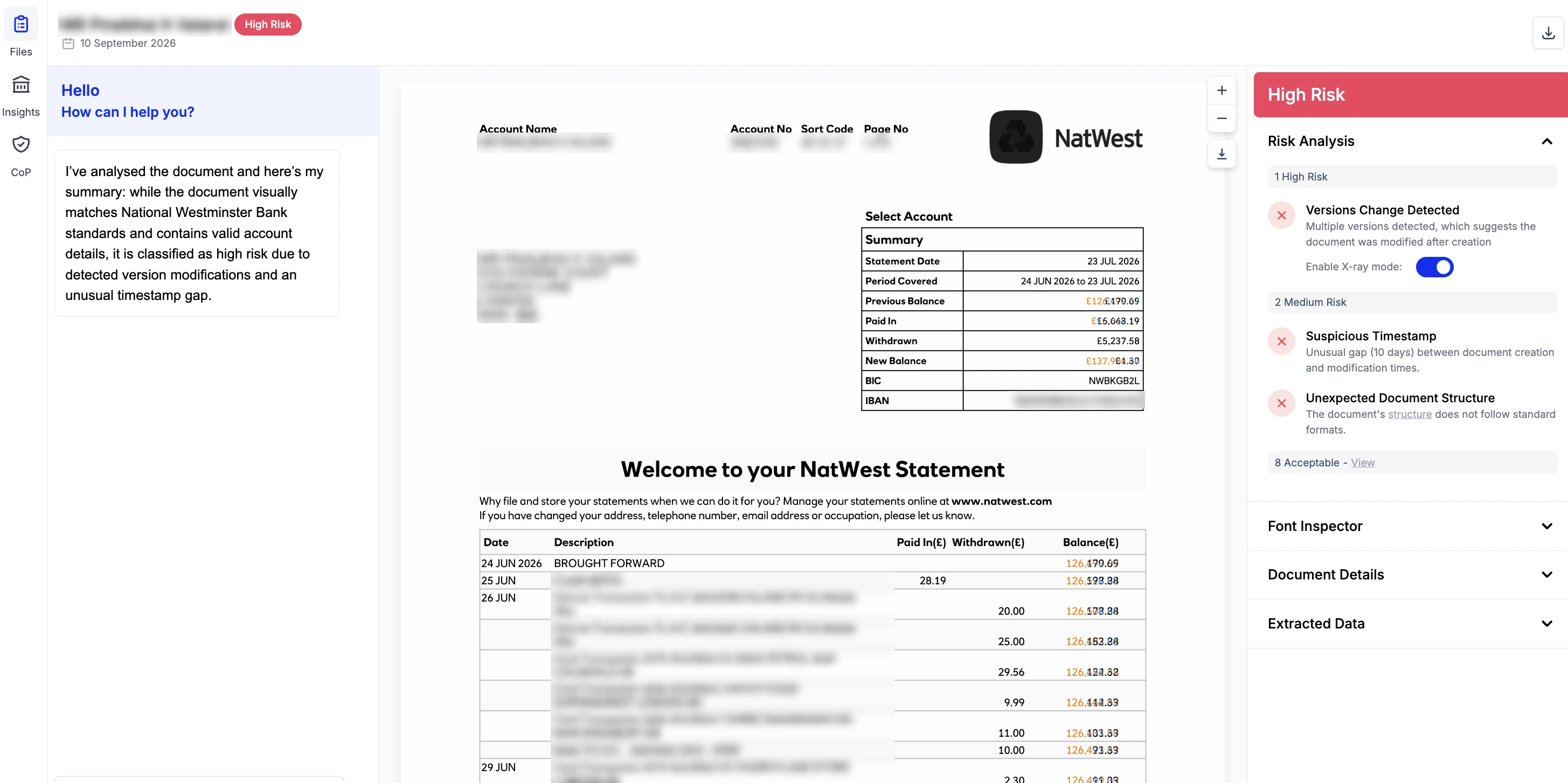
The edits left inconsistent number formatting through the first page of transactions. There was a ten-day gap between the file being created and modified, and the document's structure didn't match how that bank builds its statements.
On screen it looked like a normal statement. It's the layers underneath that gave it away.
New checks we've added
A document can look perfect and still be wrong. So alongside the forensic checks on the file itself, we've added three checks that test what the document says against the real world and against everything else we've seen.
Confirmation of Payee
We check the sort code and account number on a document against the name on the application, and get a straight match or no match back, with a reason code. In September, 1 in 11 accounts checked weren't a clean match to the applicant's name. A perfect-looking statement doesn't help much if the money's heading somewhere else. More on Confirmation of Payee.
Bank balance reconciliation
We rebuild the statement's maths line by line, from opening balance through every transaction to the closing balance, and show exactly where it stops adding up. It's how the £100k statement above got caught. More on bank balance reconciliation.
Account and data reuse
Fraudsters rarely build one fake. When the same account number turns up with a different name or address, or the same template or document data appears across applications that shouldn't be connected, we flag it. One reused document is a coincidence. The same one turning up three times is a pattern.
Which sectors saw the most tampering?
Tampering turned up in every sector we work with. In September, it was most common in property and lettings, followed by gambling and consumer lending, and then by asset finance and business finance. At the values those lenders deal in, though, it only takes one.
Letting agents and landlords, there's more on what we're seeing in rentals on our real estate page.
What should lenders do with this?
- Ask for the PDF where possible, not a photo. If someone can only send a picture of their statement, it's fair to ask why. Images can be assessed, but you get more data with PDFs.
- Give proof of address the same attention as income documents. In September, utility bills and payslips were tampered with more often than bank statements.
- Treat an unfamiliar layout as a reason to look closer, not a reason to decline.
- Check the account belongs to the applicant before any money moves.
Most of what's in this report is invisible to the eye. Edit histories, layout matching and figures that don't reconcile are what Fraudfinder's document fraud check looks at, in seconds, on every document. Fancy seeing what it finds in your own pile? Try it free.
How we put this report together
Period: 1 to 30 September 2026. Sample: every document checked through Fraudfinder in the month, excluding integrations that use us only for data extraction. "Clear signs of tampering" means at least one forensic check found direct evidence of manipulation, such as edits recorded in the file, figures that don't reconcile or creation in editing software. Documents flagged only for a lighter review aren't counted. Rates are shown as a share of each group, so a group's size doesn't inflate its rate. Breakdowns are only shown where the sample is large enough to be meaningful.
FAQs
What percentage of documents sent to lenders are fake?
In September 2026, 7.3% of documents checked through Fraudfinder (about 1 in 14) showed clear signs of tampering.
Should lenders accept photos of bank statements?
It's riskier. In September, bank statements sent as photos or scans were around 14 times more likely to show tampering than native PDFs, because taking a photo strips much of the file's edit history.
Which document is most commonly faked?
Bank statements are the most submitted document, but in September 2026 they had the lowest tampering rate of the main document types. Payslips and utility bills were tampered with more often, even when comparing PDFs only.
How can you tell if a bank statement has been edited?
Look past the surface. Edited statements often have an edit history in the file, balances that don't reconcile with the transactions, or a layout that doesn't match the bank. We cover the details in how we spot fake bank statements.