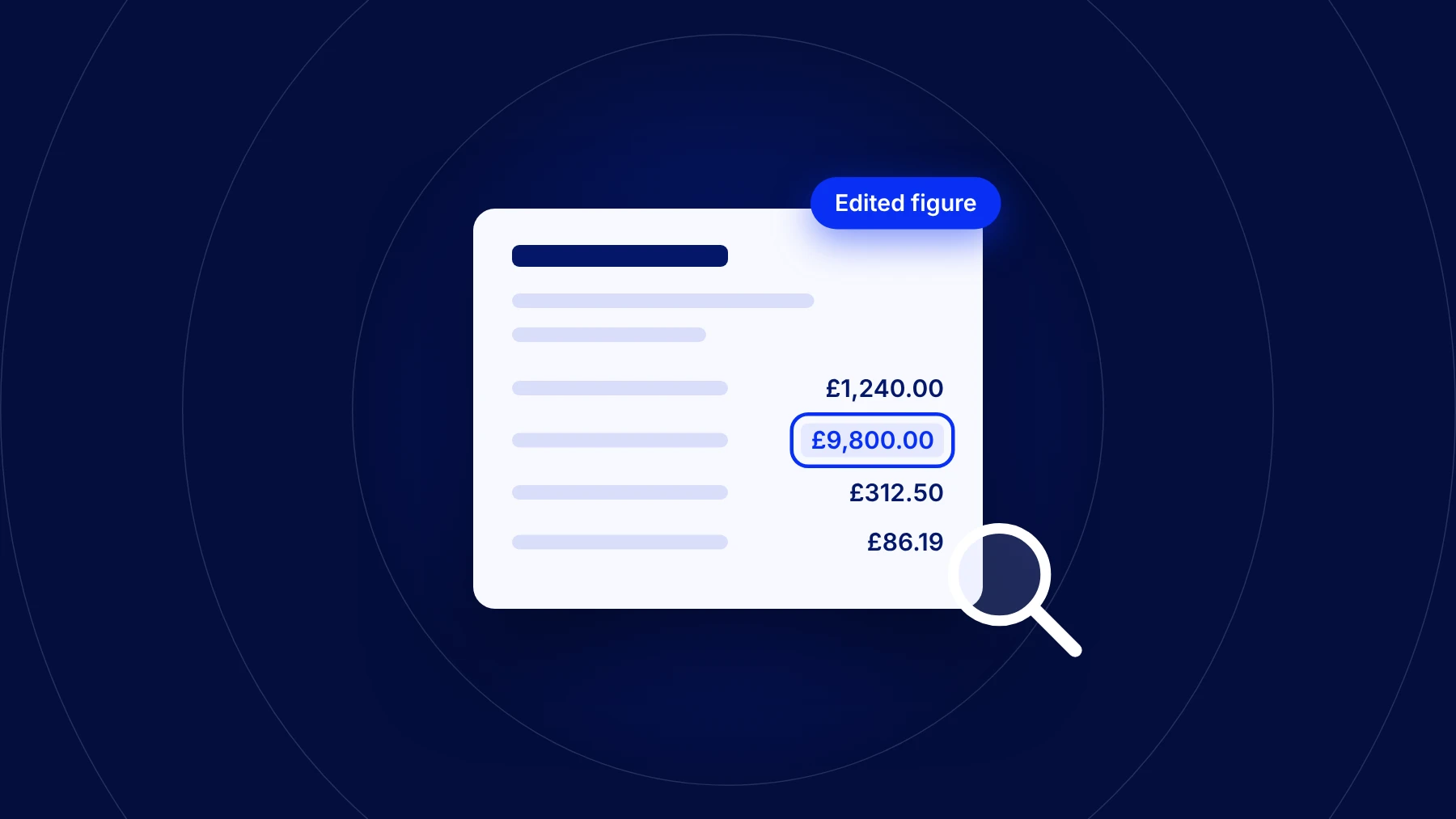
Most fake payslips are quickly edited online by someone trying to inflate their salary, change the name of their employer or the dates they were employed. The scenario we see most often is when someone opens last month's PDF, bumps the gross pay, saves it and sends it over. And a lot of the time it works, because a payslip is one page and nobody adds it up.
We see a lot of them. Around 1 in 10 of the payslips that came through Fraudfinder in October had been tampered with, and that's only counting the ones with hard proof. PDF for PDF, it's about four times the rate we see on bank statements. The numbers are all in our October 2026 document fraud report.
So whether you're a lender, a landlord, a letting agent or an employer, this is what to look for. Some of it you can do yourself with a calculator. Most of it you can't.
What does payslip fraud look like?
Pay, mostly. Gross goes up and net goes up with it.
After that it's dates. An old payslip gets rolled forward so it passes for last month's. We also see names swapped onto somebody else's payslip, employers that turn out not to exist, and deduction lines quietly removed so the take-home looks better.
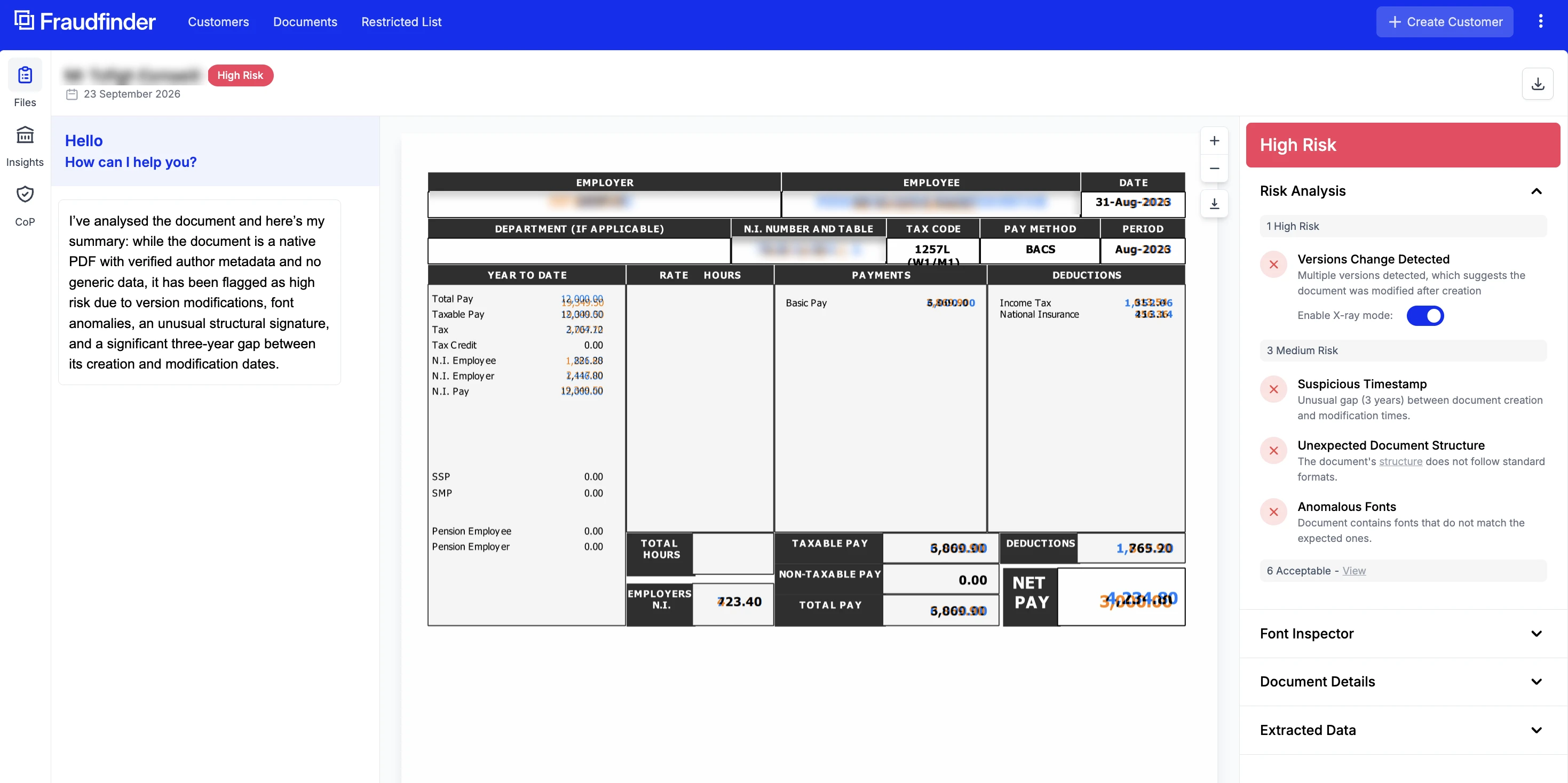
This one came through in September. On screen it was a normal 2026 payslip. It was really from August 2023, with every date changed and about £1,400 added to the pay.
What should a real UK payslip show?
Let's check what the law says. By law a UK payslip has to show gross pay, each deduction and what it's for, and net pay. Since April 2019 it also has to show the hours worked, where pay changes with the hours.
Most show a lot more than that. Tax code, National Insurance number, pay date, tax period, year-to-date totals, the employer's PAYE reference. None of those are legally required. But payroll software prints them, so a payslip without them is unusual, and unusual is worth a question.
9 fake payslip warning signs you can check yourself
You need five to ten minutes and a calculator.
- Add it up. Gross pay, minus every deduction, should give you the net pay. Sounds too obvious to bother with. It isn't.
- Look at the tax. Does it seem about right for that salary? If someone's on a lot more than their last payslip but paying nearly the same tax, ask why.
- Check the year-to-date figure. Divide it by the number of pay periods so far. You should land near the monthly pay, unless there's a bonus that explains the gap.
- Check the dates. The UK tax year starts on 6 April, so a payslip dated late August should say month 5. Pay dates should follow a pattern too. If it's the 28th every month and then suddenly the 3rd, something's been moved.
- Read the tax code. Most people with one job are on 1257L. An S at the front means a Scottish taxpayer and a C means Welsh. W1, M1 or X on the end is an emergency code, which is normal in someone's first month or two and odd after a year. BR means everything's taxed at basic rate, and that usually points to a second job.
- Check the National Insurance number. Two letters, six numbers, then a letter from A to D. It should be the same on every payslip and on the P60.
- Look up the employer. Find it on Companies House. Is it trading, and has it been around long enough to have paid the salary history you're looking at? Most payslips also carry a PAYE reference, which is three numbers, a slash, then a mix of letters and numbers. That should match the P60 as well.
- Find the pay on the bank statement. Same amount, around the same date, from the same employer. If it's not there, one of the two documents is wrong.
- Ask for more than one. Three payslips in a row are much harder to fake than one, because the year-to-date totals have to climb by the right amount each month.
None of these prove fraud on their own. Genuine payslips have odd tax codes and plain layouts all the time. They're reasons to ask.
And they'll only catch the rushed ones. Someone who's done the sums properly gets through all nine, which is where the next list comes in. There's a similar walkthrough for statements in how to spot a fake bank statement.
What does Fraudfinder check on a payslip?
A payslip looks simple. Underneath we can stess-test a lot more of the document characteristics that are undetectable by the human eye. These are the checks we run on every single payslip we encounter.
- The tax maths. We work out whether the tax and National Insurance on a UK payslip make sense for the gross pay, and whether it all lands on the net figure. People who add a few hundred pounds to their salary rarely get the tax right.
- Number formatting. Payroll software prints every figure the same way. An edit often doesn't. A comma goes missing, there's an extra decimal place, or one number sits a hair off the column.
- Version history. A PDF can keep its earlier versions inside it. One payslip we caught still had 14 of them, so we could watch the salary climb one save at a time.
- Fonts. A changed figure is often in a typeface that's close to the original. Close isn't the same.
- Metadata. What software made the file, when it was created and when it was last changed. That September payslip had three years between the two.
- Layout. Whether the payslip is built the way that payroll provider builds them. We keep a library of real layouts to check against, and add to it every month.
- Hidden and removed content. Text that's been covered over, or deleted and replaced.
- AI generation. Whether the document was made or edited with an AI tool.
- Reuse. Whether the same payslip, or the same details, has already turned up on another application.
Every flag comes back with the reason marked on the document, so whoever's reviewing it can see what changed and where.
We're not going to explain how each test works. That would be a gift to the wrong reader.
It all runs in seconds, as part of Fraudfinder's document fraud check. This is the bit a person can't do and document fraud detection software can.
Want to see a check run? Drag our edited bank statement into Fraudfinder and watch what it finds. Try it.
Can you verify a payslip with HMRC?
Not directly. HMRC won't confirm someone's payslip to a landlord, an employer or most lenders. Mortgage lenders can refer a suspected case through HMRC's Mortgage Verification Scheme, but that's for applications you already have doubts about.
So you verify a payslip from the side.
Ask for the P60. Employers issue one by 31 May, and its totals should match the year-to-date figures on the March payslip. Ask the applicant to show you their pay and tax record in the HMRC app, because that comes from HMRC and not from a PDF. And if you ring the employer, use a number you found yourself. Never the one printed on the payslip.
What about self-employed applicants?
They shouldn't have payslips at all. Someone self-employed proves income with an SA302 tax calculation and a tax year overview, both from HMRC. If a sole trader hands you a PAYE payslip, ask who the employer is.
SA302s get edited too, by the way. Same rules apply.
Found one? Check the rest
Fake documents travel in packs. In October, when one document in an application had been tampered with, the others in the same application were around 16 times more likely to be tampered with too.
Think about why. If you add £1,400 to your payslip, your bank statement has to show £1,400 more landing every month. So that gets edited as well.
If a payslip fails, don't just ask for a new copy. Go back through everything else they sent.
Why UK payslips are their own thing
PAYE has its own logic. Tax codes. National Insurance categories. Tax months that start on the 6th. Year-to-date totals that reset every April. If a check doesn't know those rules, all it can do is look at the file.
We check documents from any country. But UK payslips, P60s and bank statements are where we started, and they're still most of what we see.
So what should you do?
Ask for the PDF from the payroll portal and not a photo of it. Ask for the bank statements covering the same months. Give the payslip as much attention as the statement, because on our numbers it's the riskier of the two.
And check all of them. Sampling doesn't work when the ones that look fine are the ones that get through.
There's more on where payslip verification fits for consumer lenders, mortgage lenders, motor finance and landlords and tenant referencing.
Want to see it on real payslip fraud? Book a demo and we'll show you what we've caught, and what the report looks like.
Checking your own payslip?
Different problem. If your own payslip looks wrong, it's usually an umbrella or payroll company not passing on the tax it's taken from you. HMRC has guidance on the signs of payroll company fraud, including how to check your tax code and deductions in your personal tax account.
FAQs
Can a payslip be faked?
Yes, and it's one of the easier documents to fake. Most fake payslips are real ones with the pay or the dates edited. Some are built from scratch around an employer that doesn't exist.
How can you tell if a payslip is fake?
Start with the maths. Gross pay, tax, National Insurance and net pay should all reconcile, and the year-to-date totals should add up. Then check the pay appears on the bank statement. A careful edit won't show on the page, so the file needs checking too.
How can you tell if a payslip PDF has been edited?
Sometimes by eye. A figure in a slightly different font, or a number that doesn't line up with the column. Mostly you can't, because the evidence is in the file: its metadata, its earlier versions, its fonts. That takes software.
Can I verify a payslip with HMRC?
Not as a landlord or employer. HMRC won't confirm a payslip to a third party. Ask for the P60, ask the applicant to show their pay and tax record in the HMRC app, and call the employer on a number you've found yourself.
What should a UK payslip include?
By law: gross pay, each deduction and what it's for, net pay, and hours worked where pay varies by the hour. Most also show the tax code, National Insurance number, tax period, year-to-date totals and the employer's PAYE reference.
Is it illegal to use a fake payslip in the UK?
Yes. Using a fake or altered payslip to get credit, a tenancy or any other financial product is fraud by false representation under the Fraud Act 2006.
Are payslips faked more often than bank statements?
In our data, yes. In October 2026, comparing PDFs only, payslips showed clear signs of tampering around four times as often as bank statements.
Read next: how to spot fake documents and how to spot a fake utility bill.