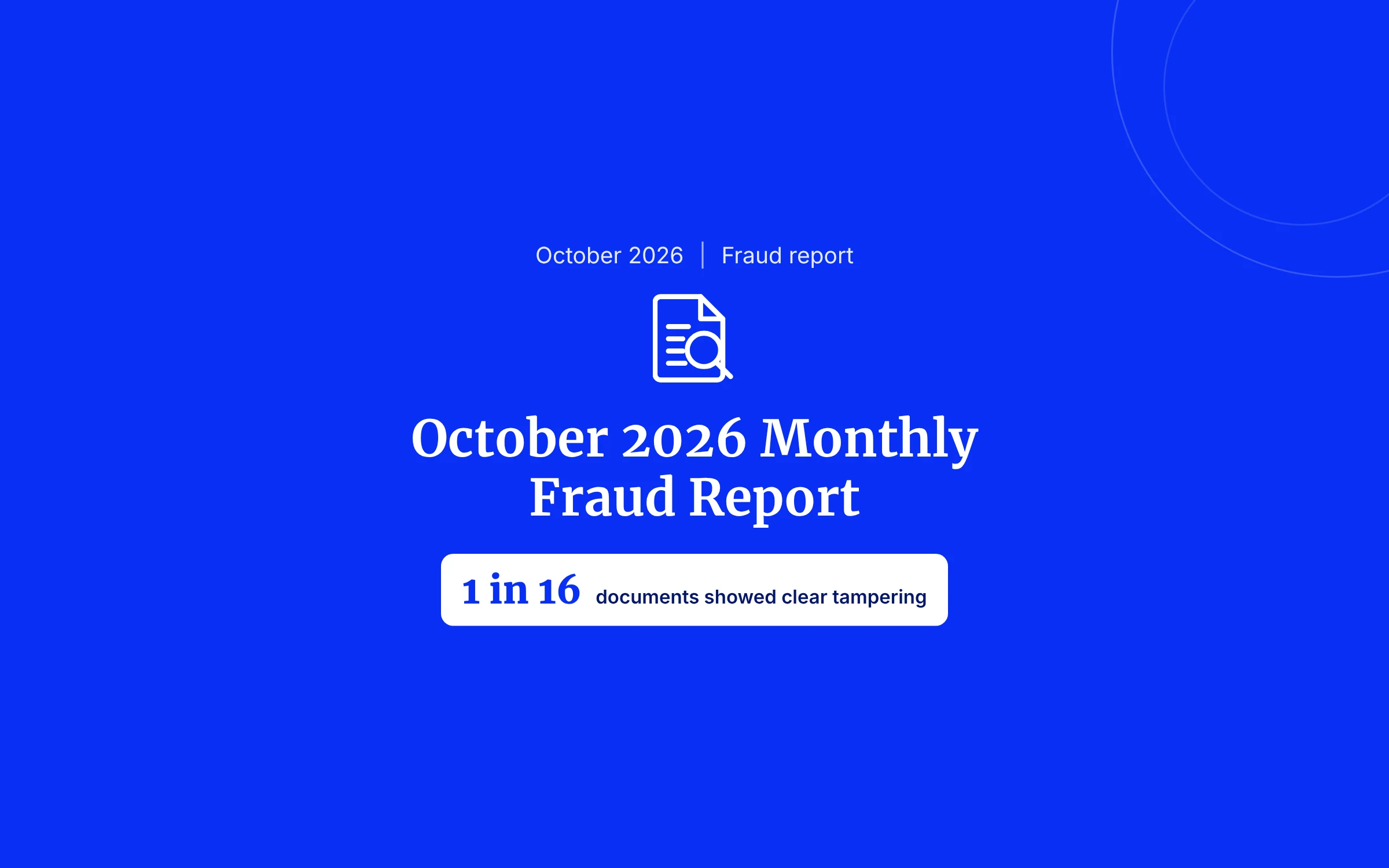
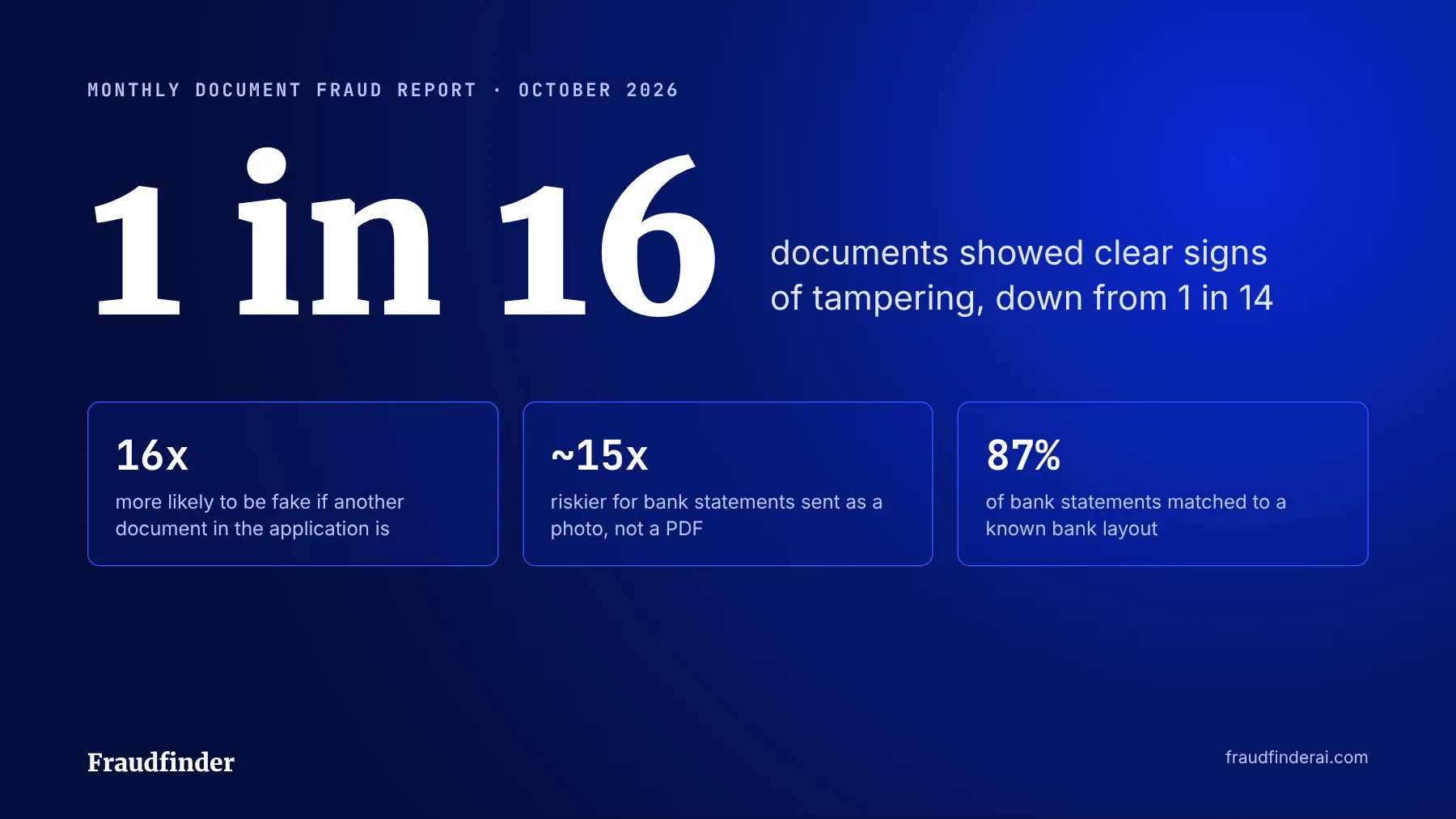
Around 1 in 16 documents we checked in October showed clear signs of tampering. That's slightly down from 1 in 14 in our September report, which is good news.
The fakes that did get through were more deliberate. And they very rarely turned up on their own.
What did we look at?
Every document run through Fraudfinder in October 2026 by lenders, landlords, letting agents, insurers and gambling operators. Mostly from the UK, plus a considerable number of Irish documents and a decent spread from mainland Europe, the US/Canada and Australia.
Same rules as last month. Every number in this report is a smoking gun: a changed figure, an edit history inside the file, or a document that's been through editing software. Hard proof, not suspicion.
So read these as the floor, not the ceiling. And it only takes one fake to get through for a lender to lose the whole loan.
Bank statements were the large majority again, with payslips and utility bills next.
What moved since September?
Mostly in the right direction.
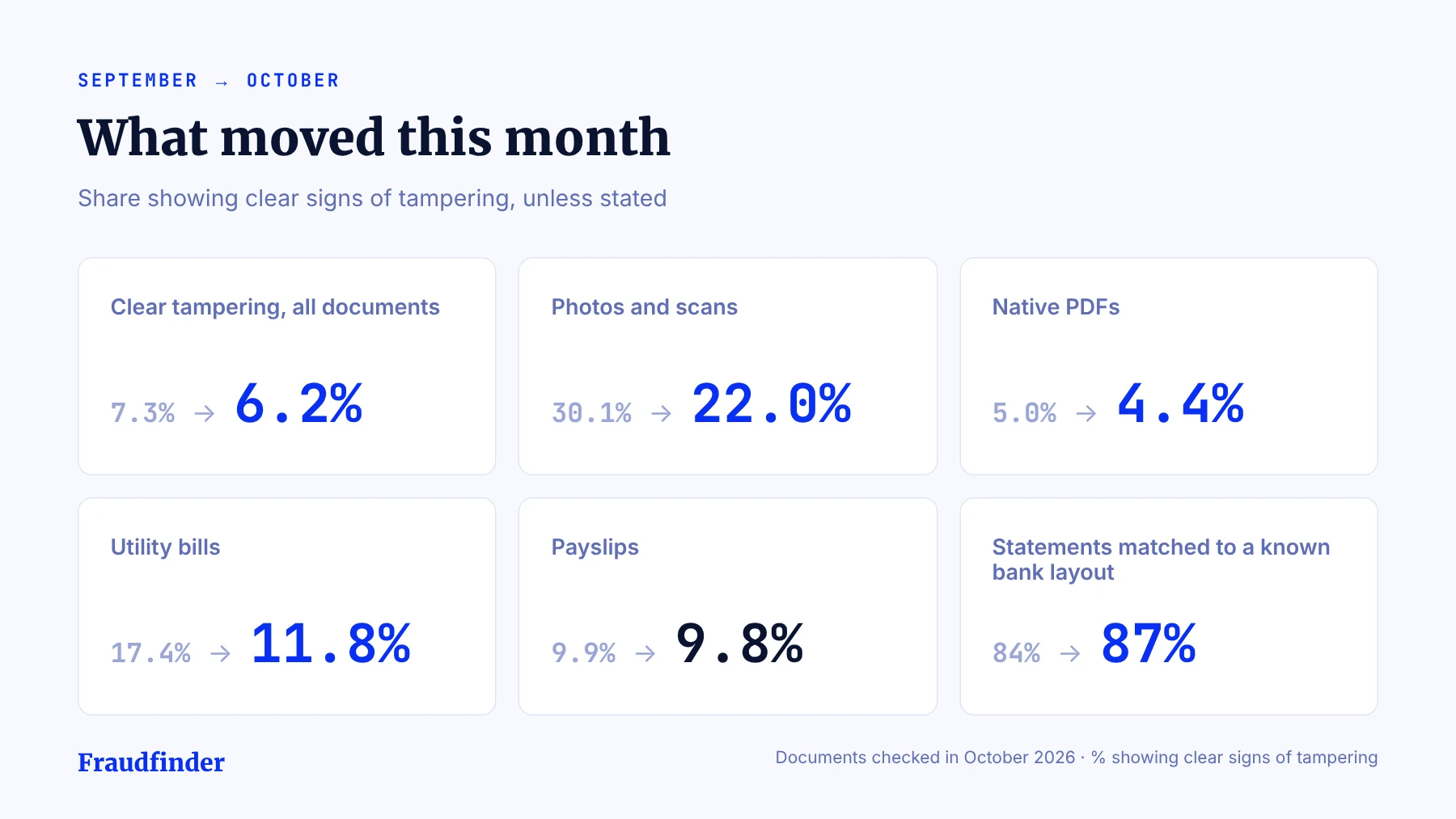
- Overall tampering fell from 7.3% to 6.2%.
- Photos and scans dropped from 30.1% to 22.0%.
- Utility bills fell sharply, from 17.4% to 11.8%.
- Payslips didn't budge. 9.9% in September, 9.8% in October.
- We matched 87% of global bank statements to a bank layout we already know, up from 84%.
That last one's down to us. Every new layout that comes through gets reviewed and added to the library, so the next statement from that bank gets checked against exactly how the real one is built. Three points in a month is a lot of new layouts.
Fraud pattern of the month: fraud travels in packs
This was the one that jumped out.
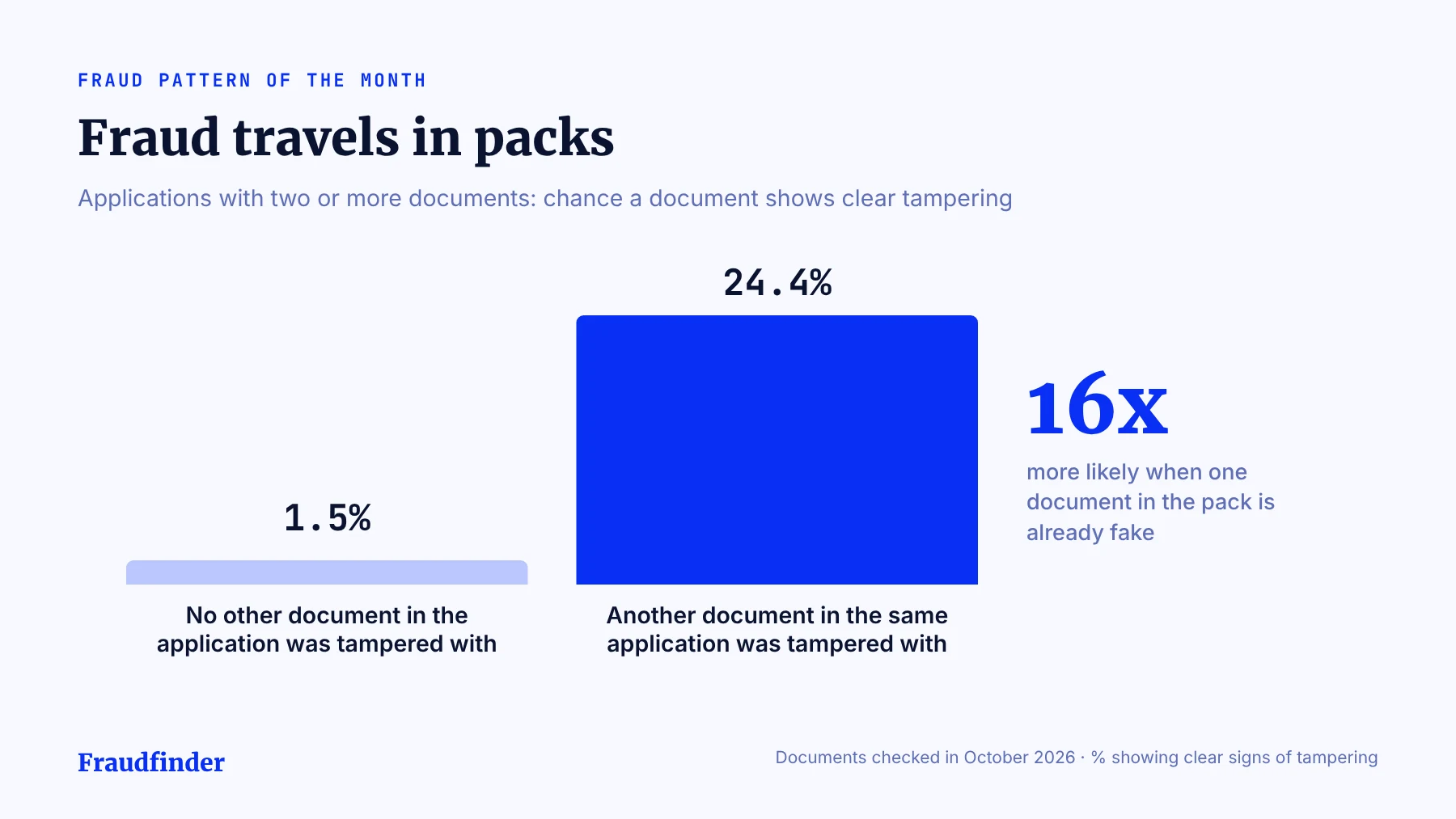
Take every application with two or more documents in it. If one document had been tampered with, the chance another one in the same application had been too was 24.4%. If nothing else had been touched, it was 1.5%.
So around 16 times more likely.
When you think about it, it's obvious. If you inflate your pay on a payslip, your bank statement has to back it up. Edit one month's statement and the next month's opening balance won't match unless you edit that too. One fake creates the need for the next.
So if one document fails, don't just ask for a new copy and move on. Go back through everything else they sent. The documents in an application should agree with each other. When one doesn't, the rest deserve a second look.
Are photos still riskier than PDFs?
Yes. The gap closed a bit in October, but it's still big.
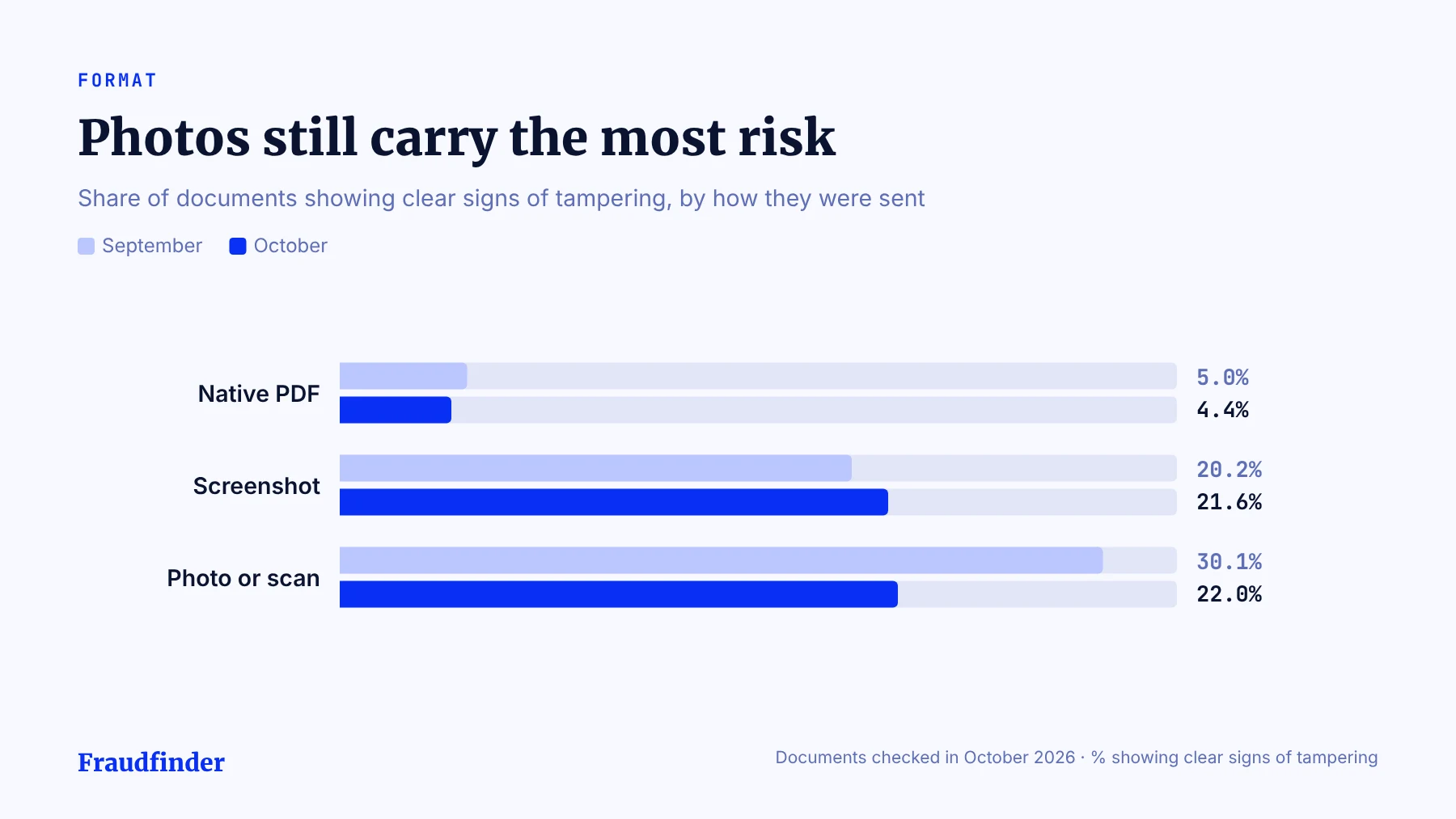
- Native PDFs: 4.4% showed clear signs of tampering
- Screenshots: 21.6%
- Photos and scans: 22.0%
For bank statements it's starker. A statement sent as a photo or scan was around 15 times more likely to show tampering than the PDF straight from the bank, pretty much where it was in September.
A PDF from the bank carries a trail: what made it, when, and whether anyone's changed it since. A photo of a printout carries far less. That's why we keep adding checks that read the content itself, and not just the file it came in. There's more on what to look for in our guide to spotting fake documents.
Payslips are the document to watch
Utility bills had a much better month. Payslips didn't.
Compare PDFs only, so the format isn't skewing anything, and around 9% of payslips showed hard proof of tampering. That's about four times the rate for bank statement PDFs.
It's not hard to see why. A payslip is one page with a handful of numbers on it, and payroll templates are easy to copy. Bump the gross pay, fix the tax and NI so they still look right, and on screen it's very convincing.
Underneath, it usually isn't. Edit histories, fonts that don't match and deductions that don't follow the payslip's own maths tend to give it away. We've written up how we spot fake payslips and bank statements if you want the detail. And given the pack effect above, a dodgy payslip is a very good reason to look hard at the statement sitting next to it.
The most edited document of the month
One bank statement we checked in October had been saved 144 times before it reached the lender. That's 144 different versions. September's record was 94.
It wasn't on its own, either. Three other statements in the same application had been through 11 to 14 versions each. The whole pack had been rebuilt.
Plenty of other documents across the month had been saved again and again before they reached us. Real statements don't usually get that much attention, and it's exactly why manual reviews are crying out for automated document fraud analysis.
One statement, two names, £6,766 richer
Here's a recent one that shows the pack problem, and our newest checks, working together. Personal details are blurred.
A Lloyds-branded statement came in on one application. Fraudfinder flagged straight away that it wasn't the original file from the bank, because it had been re-saved through Mac Preview. The account details also matched our restricted list. Closing balance: 49p.
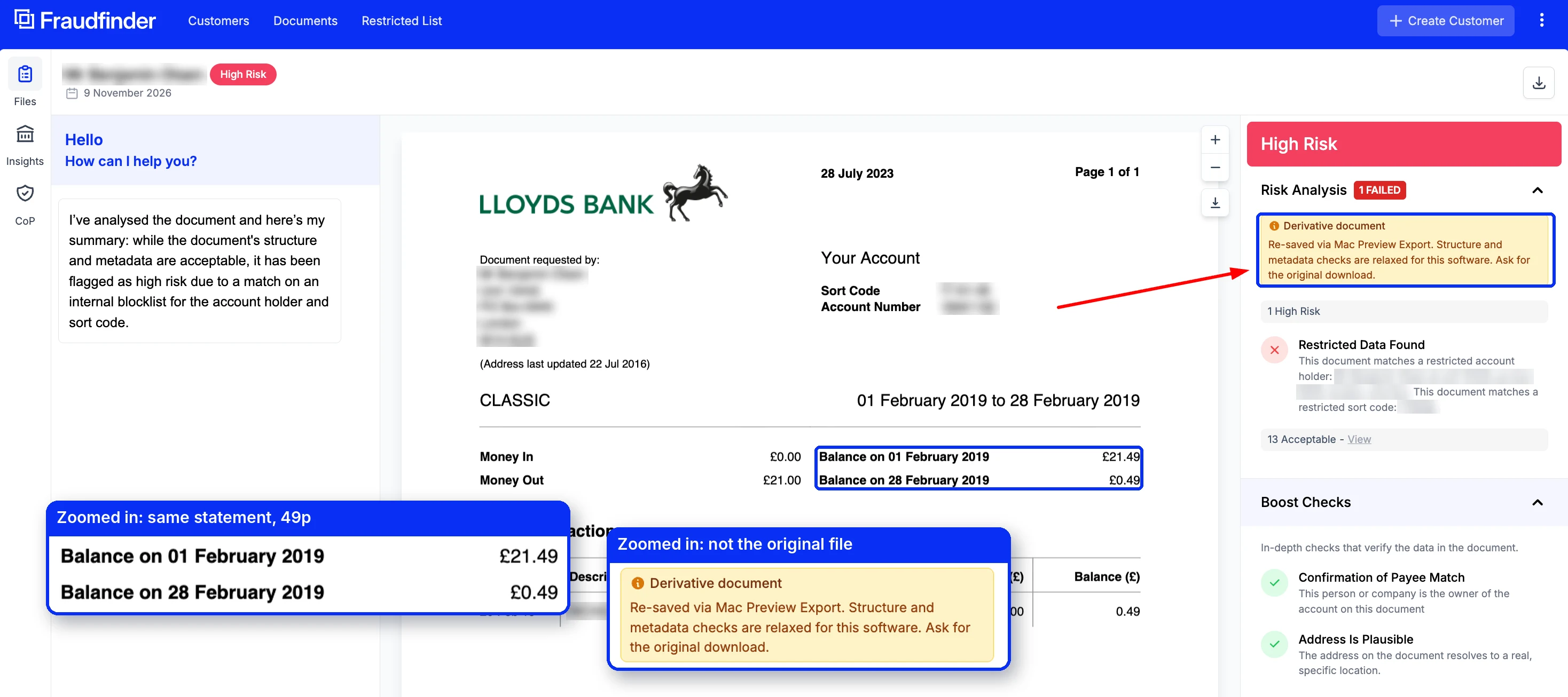
Two days later the same statement came back, on an application with a longer version of the same name. Same account, same transactions. Only now the closing balance was £6,767.
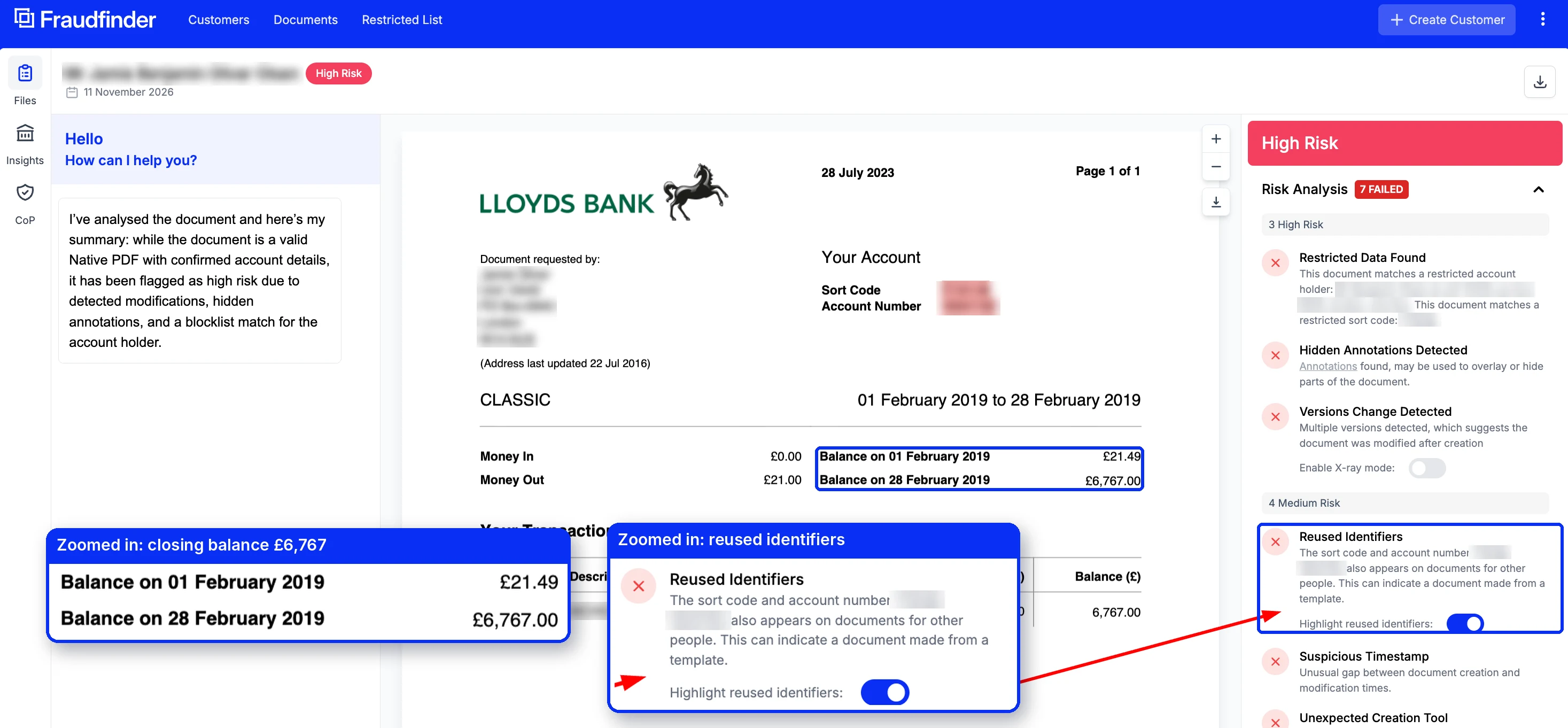
The second version failed seven checks, including an edit history, hidden annotations and a strange gap between when the file was created and last changed. But the one that ties it together is on the right: reused identifiers. That sort code and account number had already turned up on a document for someone else.
On its own, a single edited balance can slip past. Next to the first application, it really can't.
Whose bank statements get faked most?
These are statements claiming to come from a bank. None of this says anything about the banks themselves.
TSB-branded statements topped the list for the second month running, at 10.9%. Even looking at PDFs only, TSB stayed highest of the major brands. Two months in a row is starting to look like a pattern.
Remember these are smoking-gun rates only. A bank further down the list isn't a safe bank to skip checks on; it's just one where we found fewer smoking guns this month.
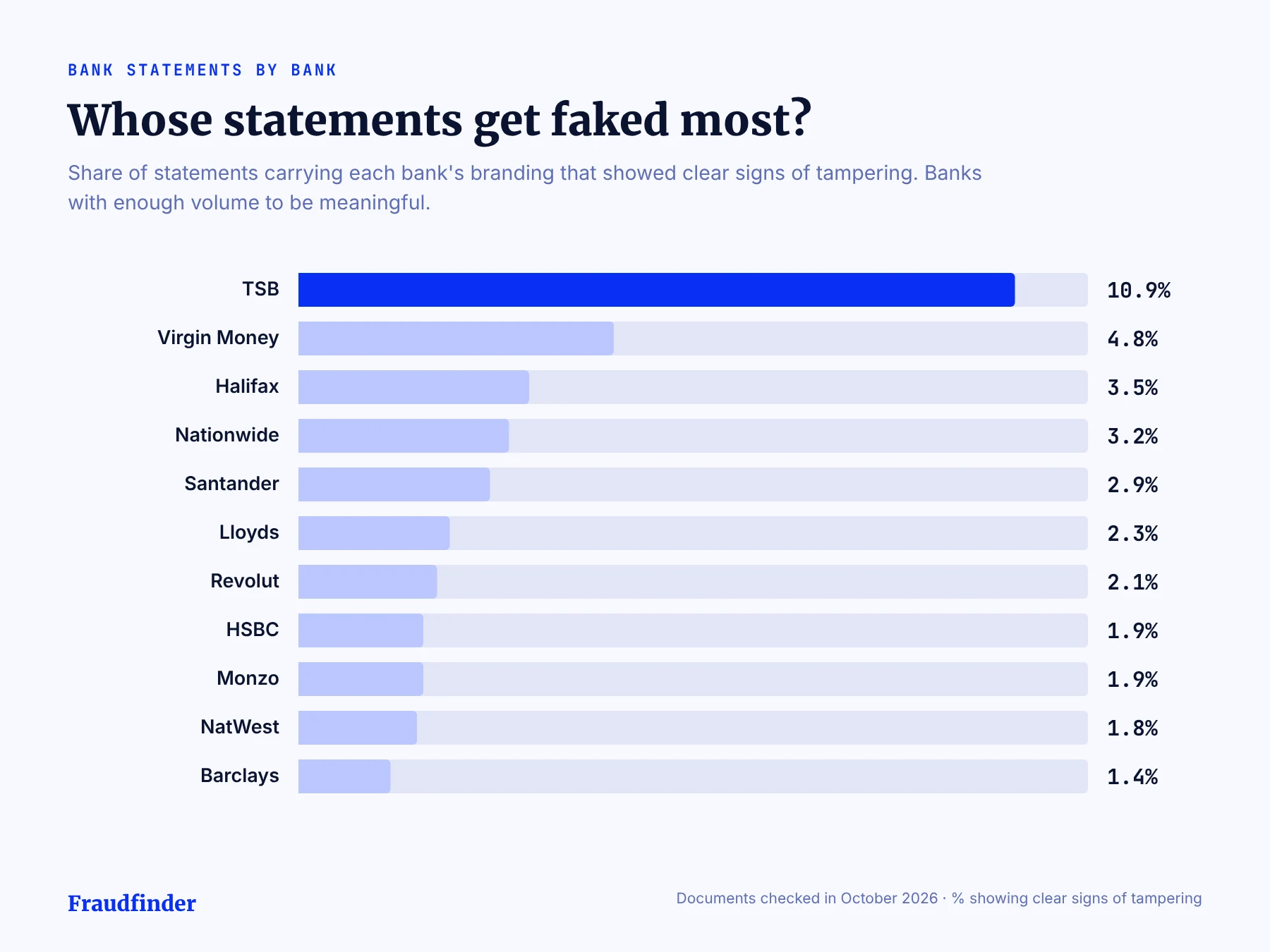
Virgin Money-branded statements rose to 4.8%, up from 3.2% in September. Halifax (3.5%), Nationwide (3.2%) and Santander (2.9%) came next. The biggest names by volume sat lower again: Lloyds (2.3%), HSBC (1.9%), NatWest (1.8%) and Barclays (1.4%).
Digital-first banks were still faked less often than the high street, at around 1.5% against 2.1%. We've been tracking this for a while, going back to the most faked bank statements of June '25.
New checks we've added in October
Checking the file itself only gets you so far. A lot of fraud only shows up when you compare a document with others, or with the real world. So that's where October's new checks went.
Reused identifiers
When the same sort code and account number appear on documents for different people, we flag it and highlight exactly where they sit on the page. It's one of the clearest signs a statement was built from a template, or borrowed from someone else.
Not the original file
Brokers and applicants re-save documents all the time, often innocently. When a file has been re-saved through something like Mac Preview or "print to PDF", we now tell you it isn't the original download and suggest asking for it. That matters a lot for broker-submitted documents, where files often pass through a few hands first.
Similar transactions
We compare the transactions on a statement with other documents we've seen, and flag lines that look lifted from somewhere else. Again, a block of identical or near-identical transactions tells us the document could be re-used from a template farm.
These sit alongside Confirmation of Payee, which checks the account on a document actually belongs to the applicant. In October, 1 in 15 accounts checked weren't a clean match, down from 1 in 11. And bank balance reconciliation still rebuilds every statement's maths line by line, which makes turning 49p into £6,767 very hard to hide. Both come with Boost.
Which sectors saw the most tampering?
We found tampering in every sector we work with. In October it was most common in property and lettings again, then gambling and consumer lending. Asset finance and business finance saw the least. Mind you, at the values those lenders deal in, it only takes one.
What does one missed fake actually cost?
Here's a rough example. Say a lender funds a £50,000 loan off the back of a doctored bank statement, and none of it comes back.
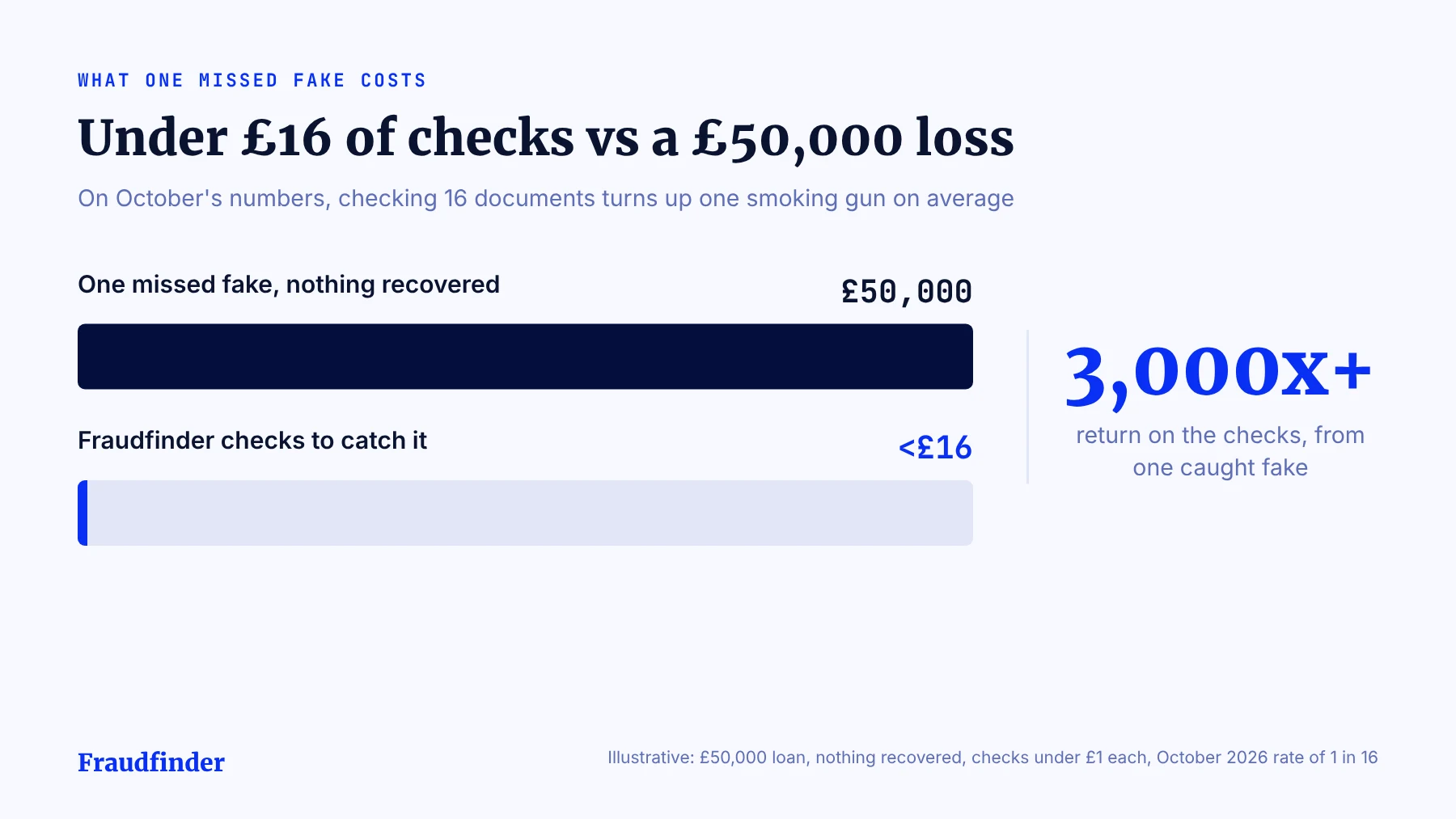
Each check costs less than £1, and on October's numbers about 1 in 16 documents showed hard proof of tampering. So under £16 of checks turns up one smoking gun on average. Catch just one and that's a return of more than 3,000 times. Your loan sizes and volumes will be different, but the maths rarely comes out close.
What should lenders do with this?
- When one document fails, check the rest. In October, a tampered document made the others in the same application around 16 times more likely to be tampered with too.
- Give payslips as much attention as bank statements. PDF for PDF, they were tampered with around four times as often.
- Ask for the original PDF. Photographed statements were around 15 times riskier, and a re-saved file is worth questioning.
- Check the account belongs to the applicant before any money moves.
Almost none of this is visible to the eye. Edit histories, layout matching, numbers that don't reconcile and links between documents are what Fraudfinder's document fraud check looks at, in seconds, on every document. Fancy seeing what it finds in your own pile? Try it free, or book a demo.
How we put this report together
Period: 1 to 31 October 2026. Sample: every document checked through Fraudfinder in the month, excluding integrations that use us only for data extraction. "Clear signs of tampering" means at least one forensic check found direct evidence of manipulation, such as edits recorded in the file, figures that don't reconcile or creation in editing software. Rates are a share of each group, so a group's size doesn't inflate its rate. We only show breakdowns where the sample is big enough to mean something, and bank figures only where no single application drives the result. September figures use the same method. The case study is from early November and is there to show the new checks in action.
Catch up on earlier months: September 2026, April 2026 and February 2026.
FAQs
What percentage of documents sent to lenders are fake?
In October 2026, 6.2% of documents checked through Fraudfinder (about 1 in 16) showed hard proof of tampering, down from 7.3% in September. That's the smoking-gun rate only, so treat it as a floor.
If one document in an application is fake, are the others likely to be?
Much more likely. In October 2026, when one document in an application showed clear tampering, 24.4% of the other documents in that application did too, against 1.5% when none did.
Are fake payslips common?
Around 1 in 10 payslips checked in October 2026 showed clear signs of tampering. Comparing PDFs only, payslips showed hard proof of tampering around four times as often as bank statements.
Should lenders accept photos of bank statements?
It's riskier. In October 2026, bank statements sent as photos or scans were around 15 times more likely to show tampering than native PDFs. Ask for the original download where you can.