It's coming up on sales calls more and more. Someone on the risk team has had a go. They've dropped a bank statement into ChatGPT, asked whether it's fake, and got back a confident, nicely written answer.
So why would you pay for document fraud detection software?
Fair question. Here's how we answer it.
Can ChatGPT detect a fake bank statement?
Sometimes. A general AI chatbot like ChatGPT, Claude or Gemini can read a statement and point out things that look odd. A total that doesn't add up. A date out of order. A font that changes halfway down the page. The better ones will dig into the file itself as well, and they can catch a careless edit that way.
What it can't do is tell you a document is genuine. It has one file and a rough idea of what bank statements look like. It doesn't know how that bank builds its statements this year. It can't ask the bank who owns the account. And it's never seen the other applications where the same details turned up.
That's where most of the fraud we catch gets caught.
What is an AI chatbot good at?
Plenty, and it'd be daft to pretend otherwise.
- Reading. It'll pull the figures off a page and sum up six months of transactions in a paragraph.
- Sense-checking a story. Does this salary sound right for that job? Do these outgoings fit someone who says they live alone?
- Explaining something unfamiliar. A document type your team hasn't seen before, or one in another language.
We use AI ourselves. So this isn't a post about AI being bad at fraud. It's about what a general model has to work with when you hand it one PDF.
Where does a chatbot fall short on document fraud?
It's got nothing to compare the document with
This is the big one. When a statement comes into Fraudfinder, it's checked against a library we've built up over years: bank and payroll layouts, documents we know are real, and documents we know were faked.
In October we matched 87% of the bank statements we saw to a layout we already knew, on a global scale. On UK statements it's above 98%. That means we can test a statement against how that bank really builds one. It's a much harder test to pass than "does this look like a bank statement?"
Our library of known and fake documents is constantly evolving. New layouts go in when banks change their designs, and new fraud patterns go in as we catch them. A general AI model doesn't have that data. It can't get it either, because it only comes from real applications. Most banks and other financial document issuers are changing their templates constantly. Whether that takes the form of adding a new T&Cs page, a new software update or a new font or pagination method. Fraudfinder sees those documents submitted by its users every day in the thousands, so can quickly determine real template updates. AI models cannot.

It only sees one document
A chatbot looks at the file you gave it. It can't tell you the same account number came through last month under a different name.
And fakes rarely turn up alone. In October, when one document in an application had been tampered with, the others in that application were around 16 times more likely to be tampered with too. You only see that if you're looking across documents. There's more in the October 2026 document fraud report.
It can't check anything outside the file
Some of the most useful checks aren't about the document at all. They're about whether the outside world agrees with it.
Take Confirmation of Payee. We ask the bank whether that name really owns that sort code and account number. In October, 1 in 15 of the accounts we checked weren't a clean match. A borrowed statement can be completely genuine as a file and still belong to somebody else. No amount of staring at the PDF will tell you that.
Catching an edit isn't the same as clearing a document
Credit where it's due. The better chatbots can now dig into a file as well as read the page, and sometimes they'll catch an edit that way. We've seen it happen.
The trouble is "sometimes". It depends on which model you're using, how you word the question and, frankly, the day. You can't build an underwriting process on that.
And catching an edit is the easier half of the job. The harder half is the document that comes back clean. Is it clean, or did the check not look in the right place? A chatbot can't tell you which.
That matters most when something's been taken away. An arrears notice. A returned payment. A loan repayment that would've changed the decision.
Here's a council tax bill from a bridging loan application worth £800,000. The applicant had deleted the lines showing they were in arrears. The text in blue is what was removed.
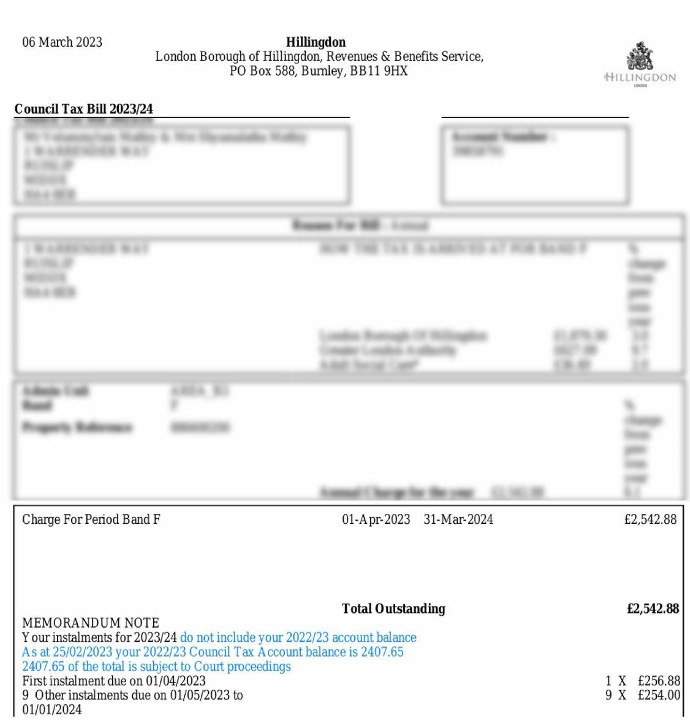
The bill looked complete. We look for that every time, on every document, and show you what was taken out.
It can get the numbers wrong without telling you
Reading a statement sounds like the easy bit. It isn't always. A long statement can trip a general model up. A debit gets read as a credit. A row gets split across two pages. A figure gets quietly tidied so the column adds up.
The trouble is you can't see it. The summary still reads well.
That's why we check that every balance follows from the one before, which is bank balance reconciliation. And it's why data extraction gives you every transaction back, where a chatbot gives you a summary.
You won't always get the same answer twice
Ask a chatbot the same question tomorrow and the wording will change. Sometimes the verdict does too. And it writes with the same confidence whether it's right or wrong.
That's fine for a first read. It's harder to live with when you're declining an application and might have to explain why six months later. Fraudfinder marks the reasons on the document itself, the same way every time, so the reviewer can see what changed and where.
It's somebody else's bank statement
Pasting an applicant's bank statement into a public AI tool can raise data protection questions. Worth a conversation with whoever owns that at your firm before anyone tries it.
For what it's worth, we're ICO registered, Cyber Essentials certified and independently penetration tested, with UK and EU data residency. The detail's in our trust centre.
Has anyone tested AI models on fake documents?
Yes, and it's worth a read. In 2025 a group of researchers gave real and forged receipts to around a dozen general AI models and asked each one to say which was which. Most scored close to a coin toss. The best one did noticeably better, but the authors still concluded that "the best LLMs show limited ability to classify document forgery". The paper's here.
Two caveats. It was receipts and not bank statements. And the models have improved since, and they'll keep improving.
But a cleverer model still only has the one file.
What does Fraudfinder run that a chatbot doesn't?
A fraud check is only part of it. On the same upload you can also run:
- Document forensics. Whether the file's been edited, and where. That's the core document fraud check.
- Confirmation of Payee. Whether the account belongs to the applicant.
- Bank balance reconciliation. Whether every balance follows from the one before.
- ID verification. Matching a passport or driving licence to a live person. More on ID verification.
- Barcode decoding. Reading the barcode on a bill or statement and comparing it with what's printed.
- Data extraction. Every transaction returned in a format your systems can use.
- AI-generated document detection. Whether the document was made or edited with an AI tool in the first place.

That last one on the list is a nice twist. The chatbot you're asking to check the document may be the thing that made it. We wrote about that when we got ChatGPT to edit a utility bill.
It all comes back in a few seconds per document.
Want to see a check run? Drag our edited bank statement into Fraudfinder and watch what it finds. Try it.
Isn't Fraudfinder AI as well?
Yes. We use machine learning all the way through.
The difference is what it's learned from and what it's plugged into. A general chatbot has learned from the public internet and it's connected to nothing. Ours has learned from real and fake financial documents, and it's wired into the bank checks, the ID checks and everything it's seen before.
Same kind of technology. Very different starting point.
So should your team use AI chatbots at all?
For reading and summarising, if your firm's policies allow it, why not. It's quick and it's good at it.
As the fraud check, no. Let it help with the reading. Don't let it sign off the document.
If you're weighing up tools, there's a list of questions to ask any vendor in how to choose document fraud detection software. Ours included.
Want to see it on real fraud? Book a demo and we'll show you what we've caught, and what the report looks like.
FAQs
Can ChatGPT detect fake documents?
Sometimes. It can spot problems on a single file, and the better models can catch a careless edit. It can't compare the file with a library of real and fake documents, check the account with the bank or see the same details reused elsewhere, which is where most fraud is caught.
Can ChatGPT create fake documents?
It can edit a picture of one well enough to fool a person. We tried it on a utility bill and the only visible clue was a slightly misplaced pound sign. That's the reason a check on the file matters more than a look at the page.
How do you check if a document is AI-generated?
Often you can't by eye. AI tools leave signs in the file that a person won't see, and Fraudfinder checks for them on every upload. Asking for the original PDF and not a photo helps too, because there's more in the file to test.
Can AI detect a fake payslip?
A chatbot can check the maths on a payslip, and that's worth doing. A careful edit gets the maths right, so the file needs checking too. There's a full walkthrough in how to spot a fake payslip.
Is it safe to upload a bank statement to ChatGPT?
If it's an applicant's statement, it's their personal financial data, so it depends on your firm's policies and the terms of the tool. Check with whoever looks after data protection before anyone does it.
What's the difference between an AI chatbot and document fraud detection software?
A chatbot gives an opinion on one file. Detection software checks the file's structure, compares it against known real and fake documents, and runs outside checks like Confirmation of Payee. It also gives the same result every time, with the reasons shown.
Read next: how to spot a fake bank statement and how to spot fake documents.