The best document fraud detection software for a UK lender checks the file as well as the page, knows UK documents, confirms who owns the bank account and shows its reasons. Plenty of tools get sold as fraud detection without doing all four.
A quick note before we start. We're Fraudfinder, so we're not going to pretend to rank our rivals. What we can do is show you how the different types of tool compare, what to demand from any vendor, and where we fit. Then you can test the claims yourself.
The short version
- Six types of tool turn up on a lender's shortlist. Only one is built to tell you whether a document is genuine.
- Data extraction, Open Banking and ID verification are all useful. None of them checks the file your applicant uploaded.
- For 2027, look for file forensics, account ownership checks and balance checks on the same upload.
- Test every vendor on documents you already know the answers to.
Who is this for?
Underwriting, fraud and onboarding teams at UK lenders: business finance, bridging, mortgages and asset finance. If you make lending decisions on bank statements, payslips and bills that applicants or brokers send you, this is your problem.
What should a UK lender look for?
- It reads the file, not only the page. Fonts, metadata, version history and layout. That's where edits show up.
- It knows UK documents. Bank statements, payslips, P60s, SA302s, council tax bills and V5Cs, from the issuers you see every week.
- It confirms who owns the account. A statement can be a genuine file and still belong to someone else.
- It checks the maths. Every balance should follow from the one before.
- It copes with photos and scans. In October 2026, photos and scans showed tampering far more often than native PDFs (22.0% against 4.4%).
- It gives a reason for every flag. Your reviewers need it to decide, and you'll need it at audit.
- It keeps data in the UK or EU, with security you can show your compliance team.
- It works on day one. A portal now, an API when you have the volume.
There's a fuller checklist, with eight questions to put to any vendor, in how to choose document fraud detection software.
The six types of tool, compared
| Type of tool | What it's good at | Where it stops for a lender |
|---|---|---|
| Manual review | Judgement and context | It can only judge how a document looks, and modern edits look right |
| Data extraction and OCR | Turning documents into data, fast | It reads an edited figure as faithfully as a real one |
| Open Banking | Data straight from the bank | It only covers applicants who connect, and never sees an uploaded document |
| ID verification | Confirming the person | It says nothing about their bank statement or payslip |
| General AI chatbots | Reading and summarising one file | Nothing to compare the file with, and no way to check anything outside it |
| Dedicated document fraud detection | Telling you whether the file is genuine, with reasons | It doesn't make the lending decision for you |
Most lenders end up with more than one of these. The mistake is assuming one of the first five is doing the sixth one's job.
Our pick for UK lenders in 2027
Dedicated document fraud detection, with account and balance checks on the same upload. Yes, that's what we sell. Here's why we built it that way.
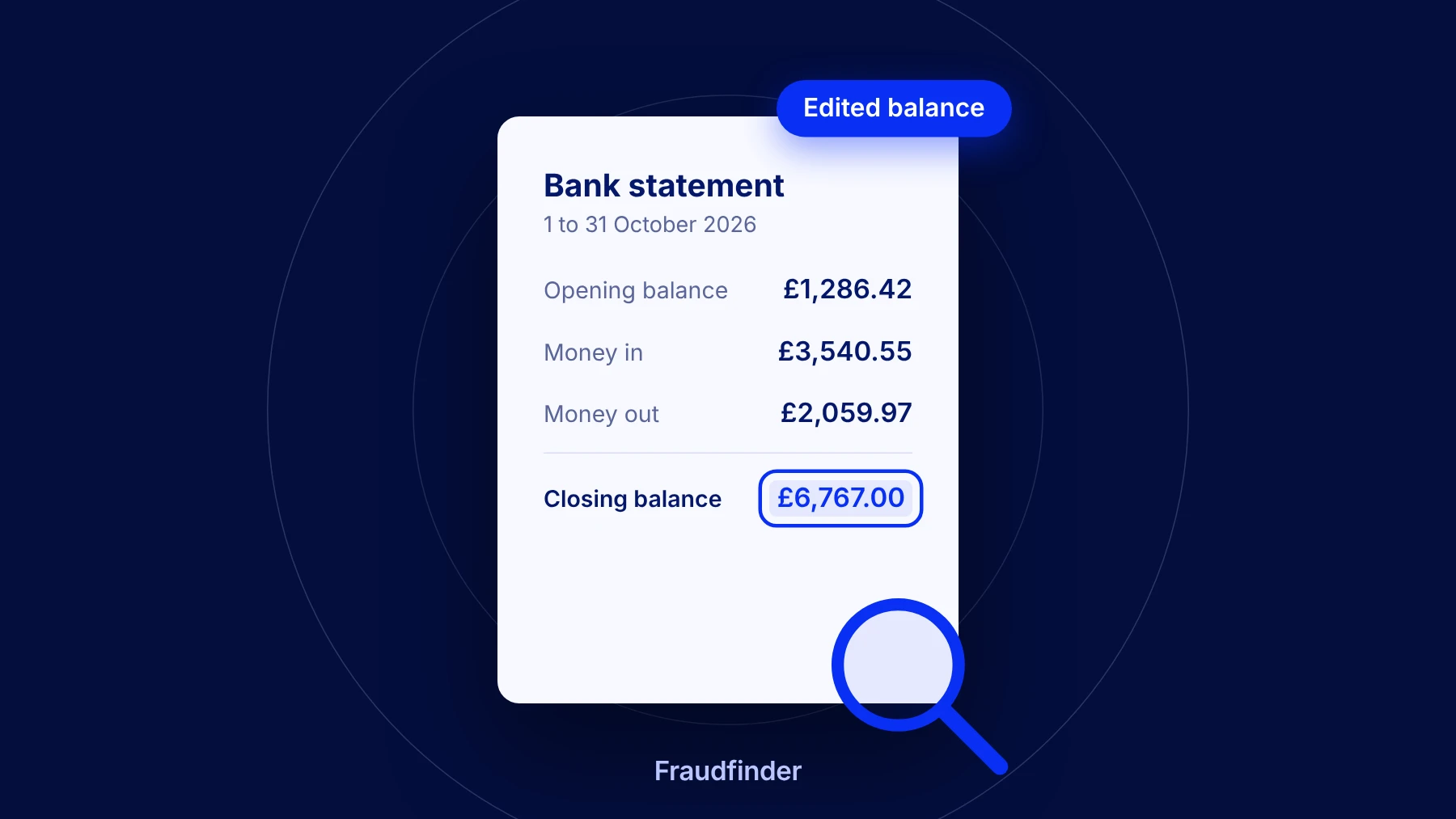
Fraud on lending documents is mostly real people stretching the truth: a balance nudged up, a salary credit changed, a line deleted. Catching that takes several checks at once, and stitching four suppliers together slows every case down.
So Fraudfinder runs these from one upload:
- File forensics. Our Document Fraud Check examines fonts, metadata, version history, layout and AI generation.
- Account ownership. Confirmation of Payee asks the bank whether the name owns the account.
- The maths. Bank balance reconciliation rebuilds a statement line by line.
- The data. Data extraction returns every transaction as JSON or CSV.
- The person. ID verification in the same portal and API.
A few things lenders tend to ask us:
- A check takes about 3.4 seconds.
- On UK bank statements, more than 98% match a layout we already know.
- Documents from any country, in any language, with translation in Boost.
- Cyber Essentials certified, independently penetration tested, with UK and EU data residency.
- Priced per document, with unlimited users on every plan.
You'll find case studies from lenders on our resources page.
Want to see a check run? Drag our edited bank statement into Fraudfinder and watch what it finds. Try it.
What should you avoid?
- Tools that only read the page. If it can't tell you the file was changed, it's data capture.
- A score with no reasons. A number on its own doesn't help a reviewer or an auditor.
- Checking a sample. At seconds per document, there's no reason not to check them all.
- Relying on one check. A clean file can still belong to someone else.
- A vendor who won't let you test first. Ask why.
How do you test before you buy?
Pick a batch of documents you already know the answers to. Include a few edits your team caught by hand and a few clean files. Run every vendor on the same batch, then compare three things: what each tool flagged, how clearly it explained why, and how long your reviewers spent on the results.
Book a demo and we'll show you Fraudfinder on real fraud, then set up a trial.
What will matter more in 2027?
Three things from our own data.
- Fakes travel in packs. In October 2026, when one document in an application had been tampered with, the others were around 16 times more likely to have been too. Tools that compare documents with each other will matter more.
- Photos are the weak spot. Applicants send them, and they carry less of a trail than the PDF from the bank.
- AI-edited documents are now routine. We see them across statements, payslips and certificates. A check for AI generation should be standard, not an extra.
The numbers are in our October 2026 document fraud report.
FAQs
What is the best document fraud detection software for UK lenders?
One that checks the file itself, knows UK documents, confirms account ownership and explains every flag. We'd say that's Fraudfinder, and we'd also say test it against anything else on your list using the same documents.
Is Open Banking enough on its own?
No. It covers the applicants who connect an account. Everyone else sends a document, and that document needs checking. More on that in our page on bank statement verification software.
Is OCR the same as fraud detection?
No. OCR reads the text on a page. It has no opinion on whether the text was changed.
Can a general AI chatbot do this?
It can give an opinion on one file. It can't compare that file with a library of real and fake documents, or check the account with the bank. There's a longer answer in can ChatGPT detect a fake bank statement?
How is document fraud detection software priced?
Usually per document or per user. Fraudfinder is priced per document with unlimited users. See pricing for the packages.
How long does it take to set up?
With a portal, the same day. An API integration depends on your systems, and most teams start in the portal while that's built.